Share of Freehold: the word that almost cost them their dream home
Back
They had found it. The flat that felt right the moment they walked through the door — the kind of right that isn't about square footage or a checklist, but a feeling. Offer accepted. Solicitors instructed. Days away from Exchange.
And then the phone rang.
Their solicitor had found something buried in the paperwork: the lease on the flat had only 81 years left.
The agent had never mentioned it. All they'd said, all along, was that the property was Share of Freehold — as if that single phrase told the whole story. As if it made the rest irrelevant.
It doesn't. And this is the part that catches even careful buyers off guard (and foreign buyers even more so!)
Owning a share of something doesn't mean the clock stops
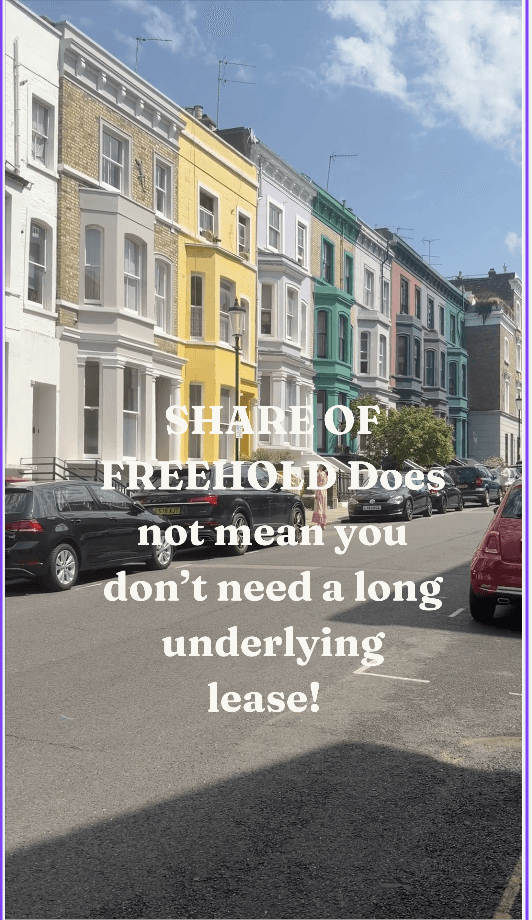
Here's the truth nobody tells you clearly enough: even when you own a share of the freehold, you still hold your flat through a lease. And that lease is still running down, year by year, whether you own a slice of the building or not.
Share of Freehold doesn't erase the lease. It just means you and your neighbours now hold the reins together — you get a say in how it's managed, but the lease itself still has a lifespan, and that lifespan still matters.
It's an easy thing to miss, because it sounds like good news. Share of Freehold has a reassuring ring to it, like something solid and yours. And it can be. But it isn't a substitute for asking the one question that actually protects you: how many years are left?
Why 80 is the number that changes everything
There's a threshold in property that quietly reshapes the whole picture: 80 years.
It's not a round number chosen for tidiness. It's the point where the maths — and the risk — shift underneath you.
Mortgage lenders change how they see the property. Once a lease drifts below 80 years, it stops being treated as a "long lease" in the eyes of many lenders. Standard lending terms can start to disappear, and with them, a chunk of your future buyer pool.
Extending the lease gets expensive — not gradually, but suddenly. Below 80 years, something called marriage value kicks in. It's a legal mechanism that hands the freeholder a share of the increase in your flat's value once the lease is extended. In plain terms: waiting doesn't just cost you time. It costs you real money, and the bill grows the longer you leave it.
When you come to sell, the same problems land on someone else's desk. A shrinking lease shrinks your pool of future buyers too — because everything above applies to them just as much as it applied to you.
None of this makes a lease like this a reason to walk away. It's not a red flag that says run. It's a red flag that says look closer, ask harder questions, and make sure the number is priced into your offer — before you exchange, not after your solicitor finds it for you.
The real lesson isn't about leases. It's about what almost happens.
What strikes me most about this story isn't the 81 years, or the marriage value calculation, or even the agent's silence. It's how close it came to slipping through unnoticed. A phrase that sounded complete — Share of Freehold — nearly stood in for a fact that changes everything.
That's how these things get missed. Not through carelessness, but through language that sounds finished when it isn't.
If there's one thing to take from this: don't let a phrase do the work of a fact. Ask the number. Every time.
This buyer had no buying agent representing them. Now they do, because they realised that they need representation.
Written from a real case, shared as a lesson for anyone buying a leasehold flat in London.